

Read More
3 min read

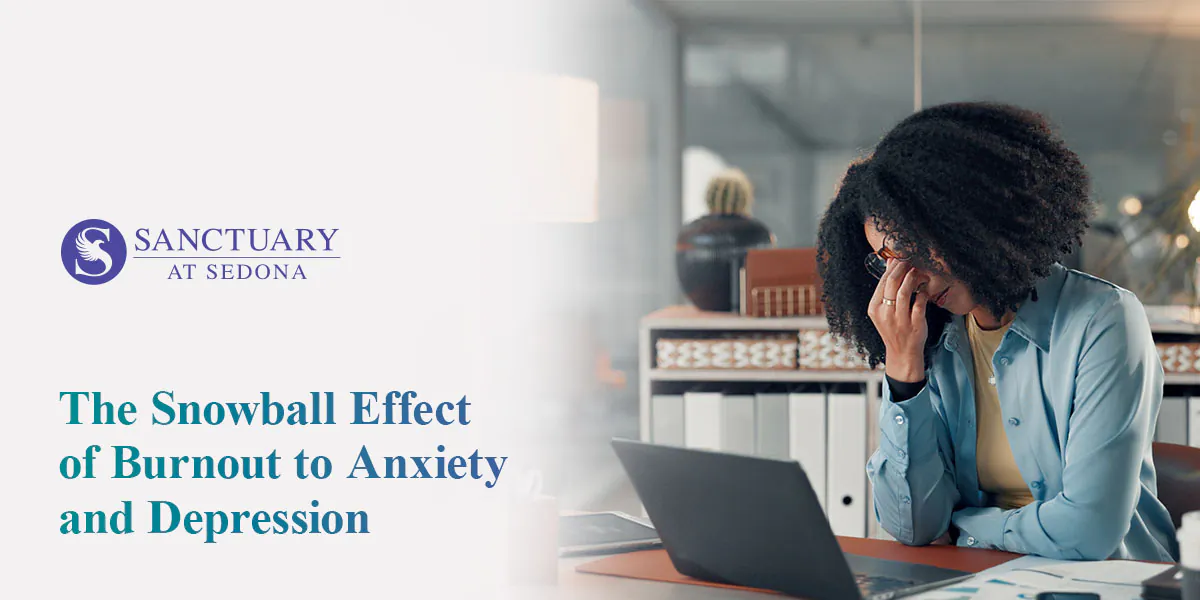
Picture a project manager who hits every deadline, answers every email within the hour, and still shows up early for the 8 a.m. standup. From the outside, nothing looks wrong. On the inside, something has gone quiet. They are running on momentum alone, executing a life they built but can no longer feel.
This is how the snowball starts. A manageable amount of stress goes unaddressed but quietly compounds until it stops looking like stress at all. What began as pressure becomes burnout, which can lead to anxiety. Unrelenting anxiety can eventually flatten into depression. Left untreated, corporate and executive burnout can lead to clinical anxiety and depression.
A holistic approach can help you address the root cause. By addressing emotional, physical, mental and spiritual symptoms, you can revitalize your relationship to work.
Burnout is not a personal failing. It produces real, documented physiological effects, beyond a vague feeling of being tired. This recognized syndrome results from chronic, unmanaged workplace stress.
Stress and burnout are not the same thing. Stress is pressure with a perceived endpoint. You might think, "Once this product launch is behind me, I can finally breathe." However, burnout is what happens when that pressure never resolves and the system stops adapting. You took the vacation, slept the whole flight there, and came back feeling exactly the same, because the underlying dysfunction was never addressed.
The World Health Organization characterizes burnout by three dimensions:
These dimensions describe a gradual erosion, not a single bad week. If you identify with them, you might have tried to rest more and quiet your mind. But there's a biological reason that approach doesn't work on its own.
When you're stressed, the hypothalamic-pituitary-adrenal (HPA) axis, your brain-to-body stress command system, initially elevates cortisol, your primary stress hormone. During stressful periods, average cortisol levels can climb to nearly 10 times those of calm periods, putting your body on high alert.
At the same time, the amygdala, the brain's threat-detection center, can become hyperreactive under this load. It starts treating ordinary pressure, like a full inbox or a tight deadline, as a genuine emergency. Meanwhile, the prefrontal cortex, which normally inhibits stress responses, becomes less effective at doing so. The result is a nervous system locked in threat-detection mode. If your threat-detection system is stuck, sleep and downtime often can't reset it on their own.
You might start to feel anxious when your system is stuck in hypervigilance. This can look like panic, racing thoughts, sleep disruption and constant worry. Research that follows employees over time suggests the relationship between burnout and anxiety runs in both directions, so each can intensify the other. And when this anxiety persists, your system can eventually exhaust itself, leaving you feeling numb in ways you never expected.
Some research suggests that under prolonged load, the HPA axis's stress response can change over time, at times shifting toward a less reactive state. Instead of flooding your body with cortisol, your system may start to respond less strongly.

Prolonged cortisol disruption can contribute to cognitive decline and mood instability. This means you could lose some of the cognitive function and emotional capacity you were relying on to function at work. For high achievers, this shift can create an identity crisis. When performance has been the foundation of self-worth, the inability to perform is not just frustrating but can leave you feeling ashamed and depressed.
Research has found a significant relationship between burnout and depression. A 2022 meta-analysis of 69 studies found a strong association between the two, and the association was stronger among people who had spent longer in the workforce. If you feel stuck in burnout, anxiety and depression, know that you are not alone. When you know why you're stuck, you can find help that addresses the issue at its source.
A vacation can offer some relief, but it rarely solves burnout and related anxiety and depression. The nervous system doesn't automatically reset once a stressor disappears. Your threat-detection process can remain miscalibrated, which may keep you in a defensive physiological posture long after the triggering deadline or project has passed.
Generalized anxiety disorder and depression can emerge within this dysregulation pattern. If you are stuck in this pattern, you might find yourself oscillating between fight-or-flight activation and a shutdown state.
While many try traditional weekly therapy to manage burnout, depression and anxiety, you might find it falling short. Therapy might focus on anxiety without addressing underlying burnout. Conversely, you might be treated for depression without taking nervous system dysregulation into account.
Without a holistic approach, treatment can leave the root intact and make you vulnerable to relapse. You need a team that helps you treat the root cause of your problem, not just manage its symptoms one at a time.
Relief often starts when you feel safe with others, in an environment where your nervous system can finally stand down. This is precisely what a small residential setting with practitioners living on-site provides.
The Sanctuary at Sedona offers a holistic, non-12-step, 30-day minimum residential program to support an immersive healing experience. We only work with a maximum of 14 clients at a time on a secluded campus outside Sedona, Arizona. Here, you can connect to yourself and our supportive team in a beautiful, serene environment.
Apart from supportive, compassionate care, our program combines medical, psychological and spiritual approaches informed by current research and indigenous wisdom traditions to address the root cause of burnout. We offer mental health treatment for anxiety and depression, including medical and psychiatric testing as well as psychotherapy tailored to your specific history.
Through our Brain-Body Recovery Lab, we offer cutting-edge technology designed to help you achieve better cognitive function, so you can better handle work tasks. We also focus on stress management, fitness and nutrition as part of a cohesive plan.
We offer corporate burnout treatment with a specific entry point tailored to your needs. This treatment is for anyone who struggles with burnout. You do not need a substance use disorder to attend, and The Sanctuary at Sedona treats both substance use and mental health conditions. With a holistic approach, you can redefine your relationship to work.

Burnout is not just work stress that fades with a long weekend. It is a neurobiological cascade, and left unaddressed, it can raise the risk of clinical anxiety and depression. None of this makes you weak or flawed. It is what chronic, unmanaged stress does to a nervous system never built to stay in defense mode indefinitely.
The cycle is not permanent. With the right comprehensive support, the nervous system can recalibrate, and clarity, energy and emotional capacity can return.
The Sanctuary at Sedona's corporate burnout treatment is designed for professionals living this exact pattern. Speak with a counselor by calling 877-710-3385, or reach out to our team online to learn how we can support your recovery from work burnout, anxiety and depression.